Urban Plant Diversity and Air Pollution Tolerance in Simpang Lima City Park, Semarang, Indonesia
DOI:
https://doi.org/10.51264/inajl.v7i1.141Keywords:
Air pollution tolerance index, Leaf traits, Semarang, Urban catchment, Urban green spaceAbstract
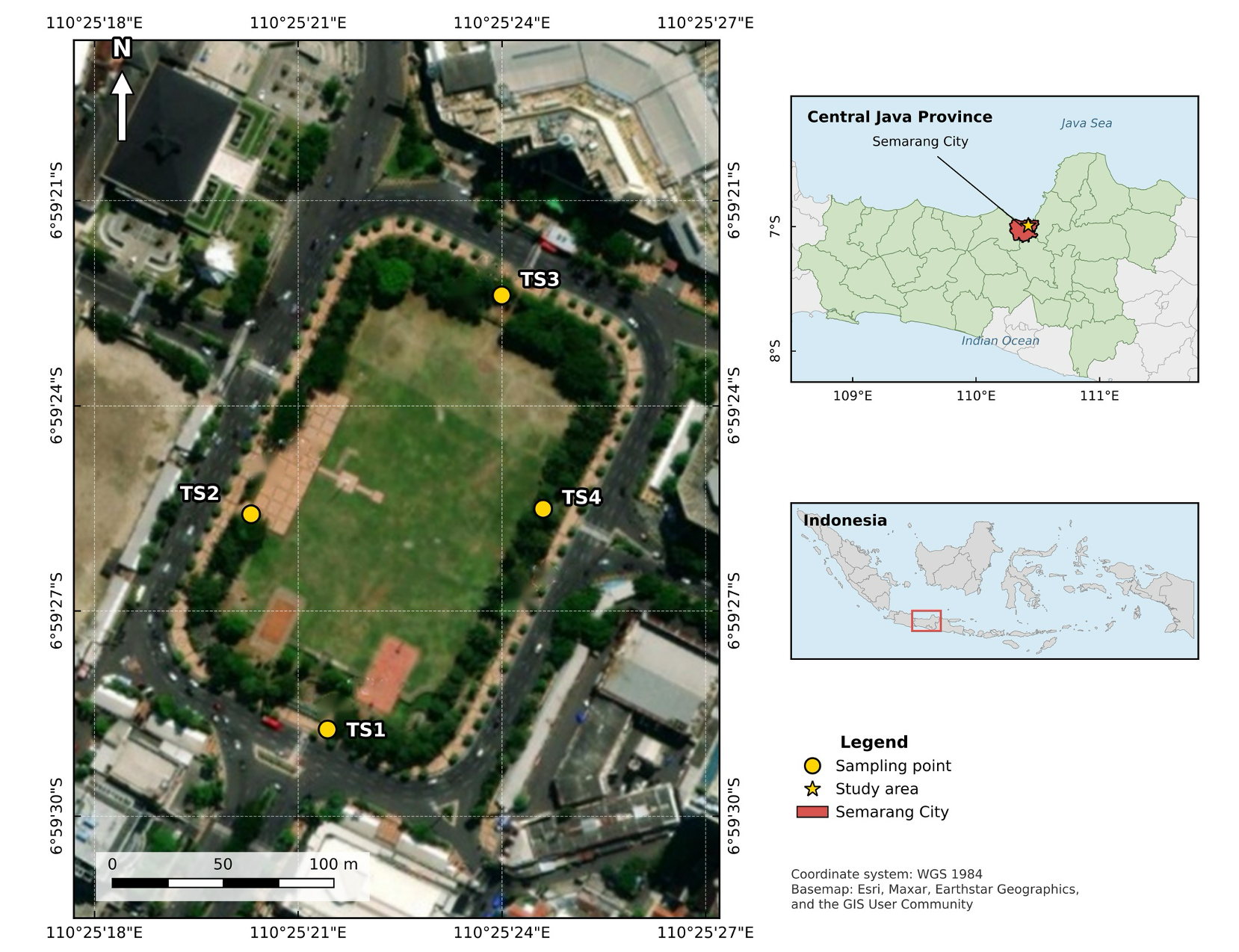
Urban parks in tropical cities are exposed to traffic-derived air pollution, and their vegetation also lies within urban drainage catchments that carry deposited pollutants to rivers and lakes. This study documented plant species diversity, the Air Pollution Tolerance Index (APTI), and leaf morphological characteristics, including leaf area and stomatal index, in Simpang Lima City Park, Semarang, Indonesia. A complete vegetation census and leaf sampling at four points around the park were carried out in March–April 2025, and APTI was calculated from foliar ascorbic acid, total chlorophyll, leaf-extract pH and relative water content. The census recorded 21,135 individuals of 21 species from 14 families (Shannon–Wiener H? = 1.92; evenness E = 0.63). Diversity was lower in the tree stratum (H? = 0.90) than in the understory (H? = 1.75), where densely planted ground covers dominated. APTI ranged from 8.87 in Pandanus pygmaeus to 40.84 in Pedilanthus tithymaloides; fourteen species were classified as sensitive, six as intermediate and one as tolerant. Leaf area and stomatal index were documented as additional morphological characteristics of the recorded plant species. Ambient pollutant concentrations, pollutant removal, runoff and receiving-water quality were not measured, so the results are a physiological screening baseline. For limnology, they identify species likely to persist in polluted urban green spaces and frame testable hypotheses on how park vegetation modifies the atmosphere–drainage–river pathway in Indonesian cities.
References
Arnon, D. I. (1949). Copper enzymes in isolated chloroplasts. Polyphenoloxidase in Beta vulgaris. Plant Physiology, 24(1), 1–15. https://doi.org/10.1104/pp.24.1.1
Bell, J. N. B., Power, S. A., & Doley, D. (2017). Plants and atmospheric pollution. In: Encyclopedia of Applied Plant Sciences (2nd ed.), Vol. 3: 332–340. Academic Press, Oxford.
Brahney, J., Weathers, K. C., & Reche, I. (2022). Dust and fog effects on inland waters. In: Encyclopedia of Inland Waters (2nd ed.). Elsevier. https://doi.org/10.1016/B978-0-12-819166-8.00069-4
Enitan, I. T., Durowoju, O. S., Edokpayi, J. N., & Odiyo, J. O. (2022). A review of air pollution mitigation approach using air pollution tolerance index (APTI) and anticipated performance index (API). Atmosphere, 13(3), 374. https://doi.org/10.3390/atmos13030374
Hamid, D. S., Yuniati, R., & Putrika, A. (2022). Trees physiological responses to air pollution in Taman Margasatwa Ragunan and UI Depok Campus. BIOTROPIA, 29(3), 254–262. https://doi.org/10.11598/btb.2022.29.3.1764
Hidayati, R., Adhi, M. A., & Mulsandi, A. (2025). Spatiotemporal modeling of acid rain chemistry in tropical Java using mixed-effects models: deposition patterns and threshold exceedance. Jurnal Meteorologi dan Geofisika, 26(1). https://doi.org/10.31172/jmg.v26i1.1170
Janke, B. D., Finlay, J. C., & Hobbie, S. E. (2017). Trees and streets as drivers of urban stormwater nutrient pollution. Environmental Science & Technology, 51(17), 9569–9579. https://doi.org/10.1021/acs.est.7b02225
Juswardi, Sa'idah, N., Aminasih, N., & Wardana, S. (2024). Air pollution tolerance of several species of trees in the petrochemical industry area using air pollution tolerance index (APTI) method. International Journal of Life Science and Agriculture Research, 3(4), 295–302.
Lohe, R. N., Tyagi, B., Singh, V., Tyagi, P. K., Khanna, D. R., & Bhutiani, R. (2015). A comparative study for air pollution tolerance index of some terrestrial plant species. Global Journal of Environmental Science and Management, 1(4), 315–324. https://doi.org/10.7508/gjesm.2015.04.006
Margahayu, H., Hariyanto, & Liesnoor, D. (2015). Sebaran vegetasi dan konsentrasi gas CO–Pb di Taman KB, Simpang Lima, dan Tugu Muda Kota Semarang. Indonesian Journal of Conservation, 4(1), 61–66.
Muerdter, C. P., Wong, C. K., & LeFevre, G. H. (2018). Emerging investigator series: the role of vegetation in bioretention for stormwater treatment in the built environment: pollutant removal, hydrologic function, and ancillary benefits. Environmental Science: Water Research & Technology, 4(5), 592–612. https://doi.org/10.1039/C7EW00511C
Naufal, M. I., Alfarishy, D. D. A., Mustaqim, W. A., Muhaimin, M., Sari, I. P., Anggraeni, R., Larasati, M., & Saputra, R. (2014). Buku Inventaris Jenis-jenis Pohon Hutan Kota Universitas Indonesia Seri 1: Wales Barat. Depok: Subdirektorat Pembinaan Lingkungan Kampus, Universitas Indonesia.
Nugraha Putra, M. D., Widada, S., & Atmodjo, W. (2022). Studi kandungan logam berat timbal (Pb) pada sedimen dasar di perairan Banjir Kanal Timur Semarang. Indonesian Journal of Oceanography, 4(3), 13–21. https://doi.org/10.14710/ijoce.v4i3.13398
Ogunkunle, C. O., Suleiman, L. B., Oyedeji, S., Awotoye, O. O., & Fatoba, P. O. (2015). Assessing the air pollution tolerance index and anticipated performance index of some tree species for biomonitoring environmental health. Agroforestry Systems, 89(3), 447–454. https://doi.org/10.1007/s10457-014-9781-7
Pielou, E. C. (1966). The measurement of diversity in different types of biological collections. Journal of Theoretical Biology, 13, 131–144. https://doi.org/10.1016/0022-5193(66)90013-0
Putri, A., Yuniati, R., & Putrika, A. (2023). Six tree species physiological responses to air pollution in Pulogadung Industrial Estate, East Jakarta, Indonesia and Universitas Indonesia Campus, Depok, Indonesia. International Journal of Advances in Applied Sciences, 12(2), 152–162. https://doi.org/10.11591/ijaas.v12.i2.pp152-162
Renberg, I., Brännvall, M.-L., Bindler, R., & Emteryd, O. (2000). Atmospheric lead pollution history during four millennia (2000 BC to 2000 AD) in Sweden. Ambio, 29(3), 150–156. https://doi.org/10.1579/0044-7447-29.3.150
Sahu, C., Basti, S., & Sahu, S. K. (2020). Air pollution tolerance index (APTI) and expected performance index (EPI) of trees in Sambalpur town of India. SN Applied Sciences, 2, 1327. https://doi.org/10.1007/s42452-020-3120-6
Salisbury, E. J. (1928). On the causes and ecological significance of stomatal frequency, with special reference to the woodland flora. Philosophical Transactions of the Royal Society of London B, 216, 1–65. https://doi.org/10.1098/rstb.1928.0001
Salsabila, S., Nugrahani, P., & Santoso, J. (2020). Toleransi tanaman lanskap terhadap pencemaran udara di Kota Sidoarjo. Jurnal Lanskap Indonesia, 12(2), 73–78. https://doi.org/10.29244/jli.v12i2.32533
Shannon, C. E. (1948). A mathematical theory of communication. Bell System Technical Journal, 27(3), 379–423. https://doi.org/10.1002/j.1538-7305.1948.tb01338.x
Singh, S. K., & Rao, D. N. (1983). Evaluation of plants for their tolerance to air pollution. In: Proceedings of the Symposium on Air Pollution Control, Indian Institute of Technology, New Delhi: 218–224.
Singh, S. K., Rao, D. N., Agrawal, M., Pandey, J., & Narayan, D. (1991). Air pollution tolerance index of plants. Journal of Environmental Management, 32(1), 45–55. https://doi.org/10.1016/S0301-4797(05)80080-5
Soeprobowati, T. R., & Hadisusanto, S. (2009). Diatom dan paleolimnologi: studi komparasi perjalanan sejarah Danau Lac Saint-Augustine Quebec-City, Canada dan Danau Rawa Pening Indonesia. Biota, 14(1), 60–68.
Soeprobowati, T. R., Tandjung, S. D., Sutikno, Hadisusanto, S., Gell, P., & Hadiyanto. (2016). The water quality parameters controlling diatoms assemblage in Rawapening Lake, Indonesia. Biodiversitas, 17(2), 657–664.
Syafrudin, Sudarno, Budihardjo, M. A., Sofia, A., & Azizah, A. S. (2026). Sediment dynamics and lead (Pb) contamination in an urban estuarine river system. International Journal of Design & Nature and Ecodynamics, 21(8), 2171–2183. https://doi.org/10.18280/ijdne.210801
Wetzel, R. G. (2001). Limnology: Lake and River Ecosystems (3rd ed.). Academic Press, San Diego.
Xu, X., Xia, J., Gao, Y., & Zheng, W. (2020). Additional focus on particulate matter wash-off events from leaves is required: a review of studies of urban plants used to reduce airborne particulate matter pollution. Urban Forestry & Urban Greening, 48, 126559. https://doi.org/10.1016/j.ufug.2019.126559
Yuniati, R., Handayani, W., Nugrahani, L., Khoerunnisa, I., Halimah, Putrika, A., & Hemelda, N. M. (2024). The capacity of trees to remove particulate matter and lead and its impact on tree health. Biodiversitas, 25(8), 2541–2551. https://doi.org/10.13057/biodiv/d250826
Downloads
Published
Issue
Section
License
Copyright (c) 2026 Sanina Kafina, Jumari Jumari, Lilih Khotimperwati

This work is licensed under a Creative Commons Attribution 4.0 International License.